
All Science News

Μosquito vectors of malaria rapidly develop resistance against new generation insecticides
More than half a million people, to their vast majority children under the age of five, die annually due to malaria, with Sub-Saharan Africa being the most highly burdened region. Mosquitoes belonging to the genus Anopheles carry Plasmodium parasites and infect humans, occasionally causing severe symptoms. Control of the mosquito vector by means of insecticides has greatly contributed to malaria prevention so far; nevertheless, these successful efforts are seriously undermined by the rapid development and spread of insecticide resistance in wild Anopheles populations. Understanding the molecular basis underlying these resistant phenotypes is crucial to ensure the effectiveness and sustainability of the currently available malaria control interventions.

The Molecular Entomology group of the Institute of Molecular Biology and Biotechnology (IMBB) of the Foundation for Research and Technology-Hellas (FORTH), led by John Vontas, Professor at the Agricultural University of Athens, has a longstanding expertise and reputation in the delineation of insecticide resistance mechanisms in malaria vectors and agricultural pests. The current study was led by Dr. Sofia Balaska and Dr. Linda Grigoraki at IMBB-FORTH as main authors, and was carried out in close collaboration with the Liverpool School of Tropical Medicine in the UK, revealing a novel carboxylesterase-mediated mechanism of cross-resistance to insecticides in Anopheles gambiae.
Actellic300S (microencapsulated Pirimiphos methyl - PM) is a new, highly effective insecticide formulation, recently introduced in malaria control campaigns in Africa after many years of development. In this study, published in the prestigious journal Nature Communications (https://doi.org/10.1038/s41467-025-65827-4), a predictive chemo-proteomic framework was developed to identify enzymes that can bind to insecticides. Application of the methodology revealed that the carboxyl-esterase Coeae6g is capable of binding to the active insecticidal molecule. Using genetic modification approaches and biochemical characterization, it was proven that Coeae6g acts like a sponge that binds PM, and prevents it from reaching its final molecular target in the mosquito’s nervous system. Transgenic mosquitoes over-expressing Coeae6g display a resistant phenotype against PM, via this sequestration mechanism. Added to that, Coeae6g was shown to act in a similar way on additional insecticides, widely used in vector control interventions, leading to cross resistance.
Given that the novel Actellic300S formulation is an important tool in controlling Anopheles mosquitoes, the findings of this study have important implications for malaria prevention efforts. Coeae6g has already been detected at higher levels in several Anopheles field populations in Africa, posing a threat on malaria control.
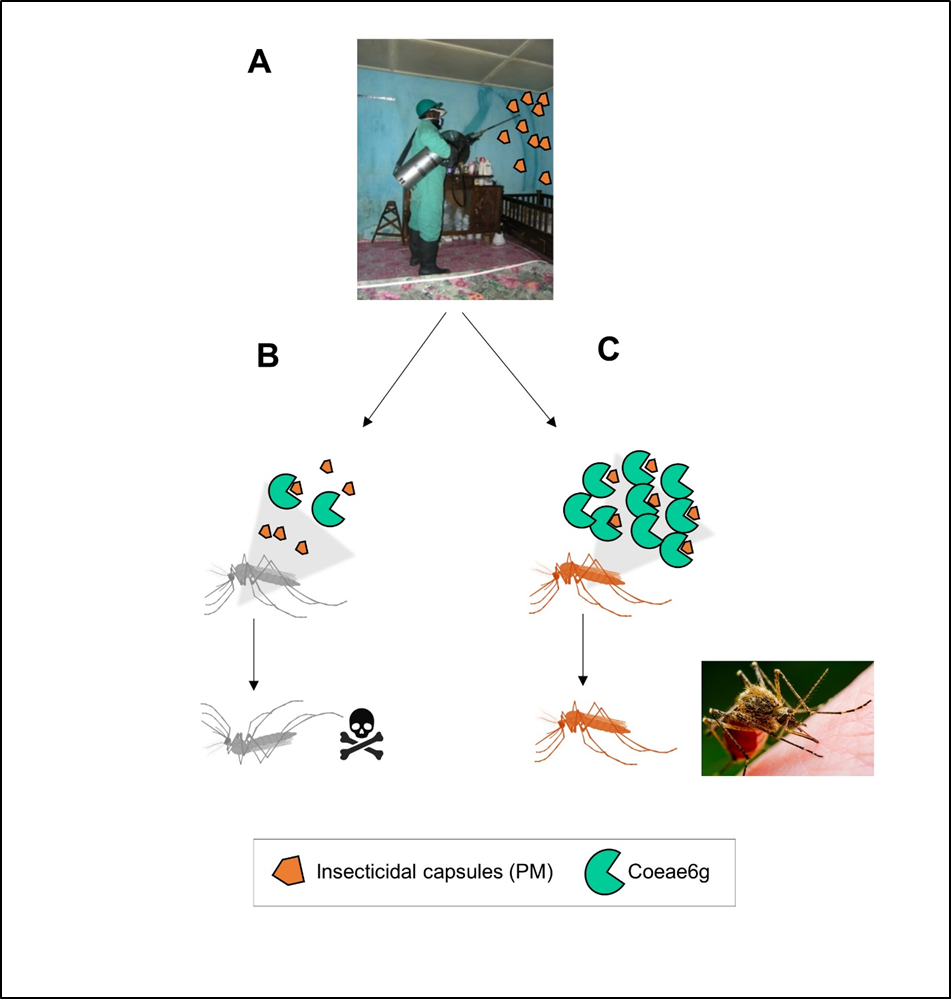
Figure 1. (A) Indoor residual spraying of household walls using new insecticide Actellic300S nanoformulations (PM). (B) Susceptible mosquitoes (gray) express low amounts of Coeae6g (green), and they tend to die upon exposure to PM. (C) Resistant mosquitoes (orange) over-express Coeae6g, that binds PM before it exerts its toxic effects. Mosquitoes stay alive and are able to blood feed on humans.